The Sober Truth: Debunking the Bad Science Behind 12-Step Programs and the Rehab Industry by Dodes Lance & Dodes Zachary
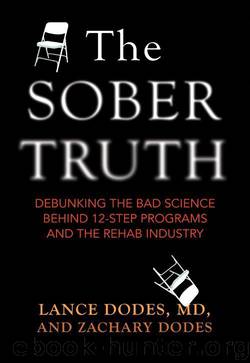
Author:Dodes, Lance & Dodes, Zachary [Dodes, Lance]
Language: eng
Format: azw3
ISBN: 9780807033166
Publisher: Beacon Press
Published: 2014-03-24T16:00:00+00:00
HOW TO TREAT ADDICTION
Understanding the psychological contours of addiction also provides a road map for how to treat it. No longer is it necessary to adopt special spiritual beliefs or join a cohort of people who all suffer with the same problem. Unlocking addiction brings it back down to earth. The problem becomes ordinary, no more or less manageable than any psychological challenge; it needs no special category; it is a psychological problem and can be managed as such.
People who have this symptom can learn how it works within them and develop the agility to solve the issues that lie behind it. For instance, once people view their addiction as a mechanism to solve feelings of overwhelming helplessness, then it becomes critical to identify what is overwhelming for them—what sort of events or feelings carry powerful emotional significance. Being stuck on a call with the bank is frustrating for everybody, but for someone who used to spend hours every week as a child waiting to speak to his estranged father by phone, it carries a particular resonance and power.
Addictive thoughts are never random. To unlock this puzzle, addicts must focus on when the addictive thought first appears. This is the key moment, the pivot point on which everything else turns. By analyzing what happened immediately before this moment—what was just felt or just thought—they can shine a light on the central issue. Yes, each moment is different, and no two people are the same. But we can be certain that they all have something in common: a unifying theme of helplessness about particular issues that are crucial to them. Anyone can learn to recognize these issues for him or herself. Once known, they become far easier to master. People find that they can pause and develop perspective on what is happening. Marion, for instance, knew that her problem was being excessively meek, and this allowed her to pause long enough to understand why she suddenly had the urge to take her pills. Once she realized what was happening, she was able to devise a more direct action to deal with the helplessness. She also gradually found that she could anticipate when the next addictive urge would occur, because she knew what circumstances led to these feelings.
There is always a more direct response to helplessness; this is the lesson to be learned from understanding addictive acts as displacements. It would be beyond the scope of this book to describe all the different ways helplessness can manifest and all the ways people can address these feelings in constructive ways (but many examples can be found in Breaking Addiction).13 For now I will simply say that addiction can be understood, managed, and ended through learning about oneself. People can do a lot on their own, but it is often faster and more helpful to explore these kinds of underlying issues with a professional. For working out these issues permanently, a good psychotherapy is the best approach.
Understanding the nature of addiction helps us clarify why AA, and AA-based rehab programs, have had such limited success.
Download
This site does not store any files on its server. We only index and link to content provided by other sites. Please contact the content providers to delete copyright contents if any and email us, we'll remove relevant links or contents immediately.
Unwinding Anxiety by Judson Brewer(73414)
The Art of Coaching by Elena Aguilar(53639)
The Fast Metabolism Diet Cookbook by Haylie Pomroy(21252)
Rewire Your Anxious Brain by Catherine M. Pittman(18794)
Healthy Aging For Dummies by Brent Agin & Sharon Perkins RN(17121)
Talking to Strangers by Malcolm Gladwell(13533)
The Art of Thinking Clearly by Rolf Dobelli(10709)
Mindhunter: Inside the FBI's Elite Serial Crime Unit by John E. Douglas & Mark Olshaker(9513)
Crazy Rich Asians by Kevin Kwan(9412)
The Compound Effect by Darren Hardy(9144)
Tools of Titans by Timothy Ferriss(8589)
Periodization Training for Sports by Tudor Bompa(8414)
Becoming Supernatural by Dr. Joe Dispenza(8366)
Wonder by R. J. Palacio(8237)
Bodyweight Strength Training by Jay Cardiello(8027)
Crystal Healing for Women by Mariah K. Lyons(8003)
Change Your Questions, Change Your Life by Marilee Adams(7927)
Nudge - Improving Decisions about Health, Wealth, and Happiness by Thaler Sunstein(7849)
Therapeutic Modalities for Musculoskeletal Injuries, 4E by Craig R. Denegar & Ethan Saliba & Susan Saliba(7779)
